Vikram ran a 1,200-person auto-components company in Pune, and he ran it the way he believed a good leader should: with instructions.
Every Monday at 8 a.m., his managers received a list of forty points, every one precise. The plant ran like a Swiss watch, and Vikram was quietly proud that nothing moved without him.
Then, one Tuesday, his heart gave way. He had emergency bypass surgery, and his doctors ordered six weeks of complete rest.
Within ten days, the watch had stopped. Dispatches slipped. A major customer’s complaint sat unanswered for four days. Suresh, the production head, had twenty-two years in the company and knew every machine by its sound. He telephoned the hospital to ask which supplier should be paid first.
Suresh was perfectly capable. In twenty-two years, though, he had never been allowed to decide.
Meanwhile, something unexpected was happening in the hospital corridor. Vikram’s sixteen-year-old son, Aarav, was a boy his father had never trusted to book a train ticket. With Vikram in hospital, Aarav’s mother simply told him, “You handle it.” Nobody gave him a list. He built a visiting roster for relatives, tracked the insurance paperwork, and coordinated the medicines with the night nurse. When a claim was rejected, he found out why and resubmitted it before anyone else knew there was a problem.
Lying in his hospital bed, Vikram watched this and felt something shift. His son, who had been handed ownership, was leading. His managers, who had been handed instructions, were waiting.
That evening, he sent one message to Suresh:
“You know this plant better than I do. Decide. Whatever you choose, I will stand behind it.”
Suresh replied within a minute: “Sir, in twenty-two years, this is the first time you have said this.”
When Vikram returned, the Monday list was gone. In its place was a Monday question:
“What will you own this week?”
The first few weeks were uncomfortable. Mistakes were made, and Vikram had to bite his tongue more than once. But within months, his managers were solving problems before they reached his desk. And at home, Aarav no longer waited to be told anything.
The Reflection
Instruction hands over a task, but ownership hands over trust. When we instruct, people learn to wait for us. When we hand over ownership, they learn to contemplate, decide, and recover from their own mistakes. That is the only way leaders are ever made.
Whether you lead a company or raise a child, three shifts make the difference:
- Ask instead of tell. “What do you feel we should do?” builds more capability than any perfect instruction.
- Hand over the outcome, not the steps. Say where it must end, and let them find the path.
- Let them be wrong safely. A mistake made with your backing teaches more than a success made under your direction.
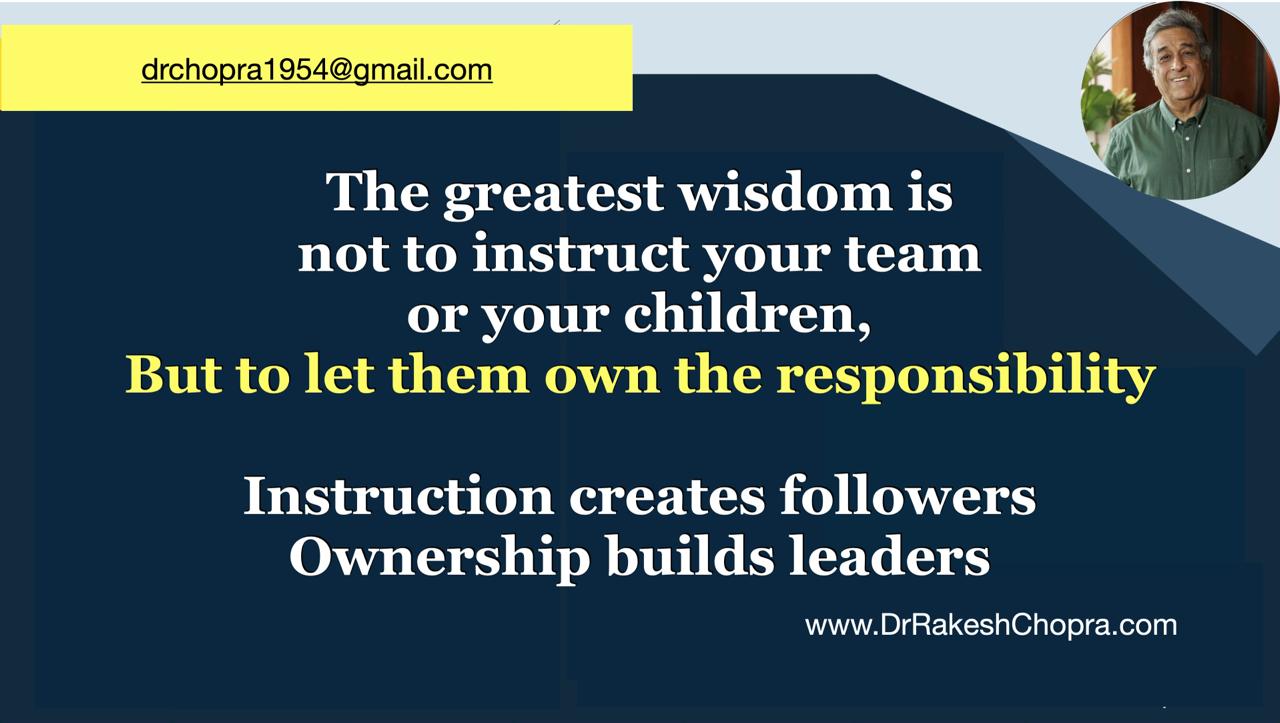
The greatest wisdom is not to instruct your team or your children, but to let them own the responsibility. Instruction creates followers. Ownership builds leaders.
Request a conversation →